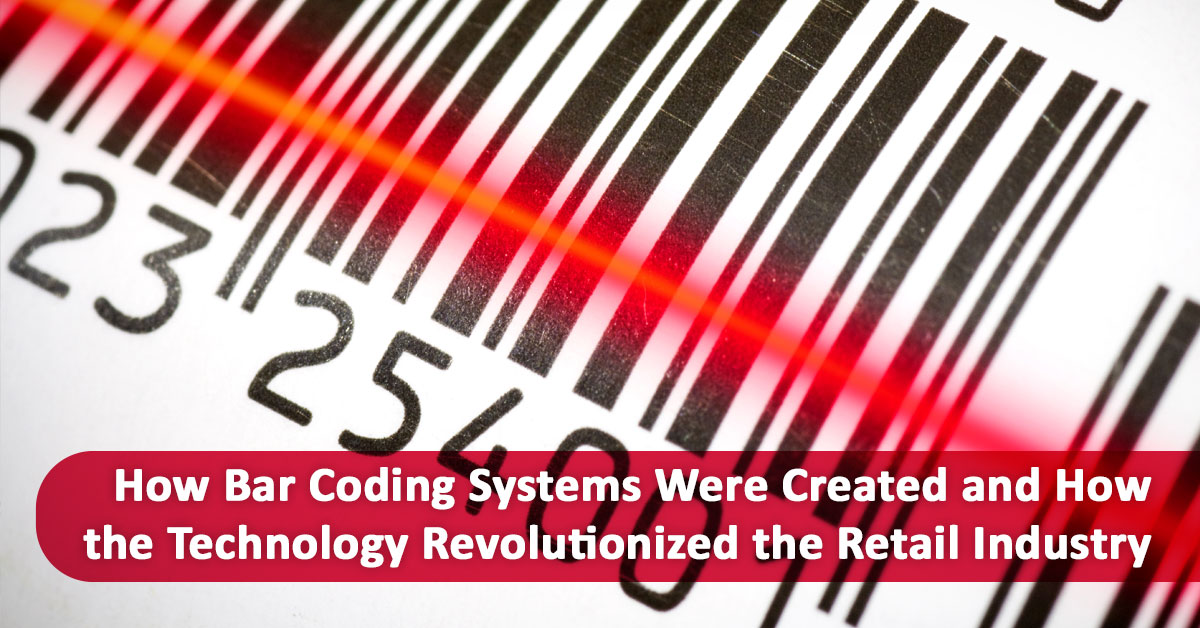
Most people use bar codes on an almost daily basis. They make all sorts of businesses more productive, get packages delivered more swiftly and accurately, and accelerate grocery shopping as items are quickly whisked across scanners as fast as hands can move them.
Bar codes have become an integral part of our lives – and many of our jobs. However, where did they come from, and how have they developed into the technology in place today?
Who Invented the Bar Code?
Bar codes have been in existence for decades, with early development dating as far back as 1951, when Norman Joseph Woodland and Bernard Silver filed their patent for the invention. The origin of their idea was to transform the Morse code system of dots and dashes into a series of thick and thin lines that represent unique characters that could be interpreted by readers. Woodland and Silver’s first bar code reader was built in 1952.
An early application was utilized by railroads in 1962 to affix plates containing bar codes on each side of rail cars. These bar codes were read by trackside scanners to identify attributes of each car such as owner, model of car, and other pertinent information.
Innovation and technology persisted, generating multiple ideas and attempts at creating commercially accepted retail bar coding:
- 1970 – National Association of Food Chains establishes a committee to develop a uniform system of product bar codes
- 1972 – RCA worked with grocer Kroger to test a system that incorporates a bull’s-eye bar code format
- 1973 – Universal Product Code (UPC) is introduced to open the doors for the adoption of commercial bar code technology
- 1974 – The first bar coded product is scanned at a Marsh supermarket in Ohio – a package of chewing gum
- 1984 – one-third of grocery stores had installed bar code scanners
- 1994 – Automotive industry develops QR bar codes for tracking vehicles and components
Today, nearly every product is identified by a bar code of some type, from school supplies to computers to clothing. Even smartphones are equipped with scanners that can read multiple types of bar codes.
How Bar Code Technology Revolutionized the Retail Industry
One industry most directly impacted since the introduction of bar code technology is retail operations. Whether the product is a men’s shirt in a department store or a bottle of wine in a grocery, an affixed barcode provides the retailer with valuable information that may include:
- Price
- Product identification
- Where the product was manufactured
- The lot number of the item, to determine expiration dates
Retailers not only use bar code information at the checkout area but in many other innovative ways:
- Fast and accurate inventory counting
- Inventory control for managing older products and pulling expired or recalled products
- Scanner data can drive the ordering of new products to replace units sold
- Analysis of readily available information tells the marketing department what products are selling, at what volumes, and at which stores
- With real-time access to data collected by bar code scanners, retailers can work more cohesively with suppliers to ensure products are ordered and shipped to the locations that are most likely to sell their products, which improves profitability
- Service to customers is significantly enhanced with bar coded merchandise and scanners. It’s hard to imagine going to a supermarket or any retailer and encountering a checkout line where the cashier keys in prices of every item
Bar Coding Must Be Done Properly
With all the advantages of bar code technology, there are also cautions and risks that retailers and other industries must be aware of:
- Bar codes that are not printed properly or utilize sub-standard materials can result in labels that are not able to be scanned by automated scanners. This can impact productivity in checkout lines and reduce inventory accuracy.
- Now that retailers rely heavily on bar code accuracy and validity, improper labeling or missing labels impact them financially, and suppliers may be subject to fines or chargebacks for failure to provide consistent quality or for non-standard bar codes.
Suppliers and retailers need to use quality bar code equipment and supplies to maintain dependable bar code results.
Your Bar Coding Specialists – AISink
AISink is a premier provider of bar code technology, offering our customers a complete line of quality bar code scanners, printers, and accessories. We provide units from the premier manufacturers in the industry, including Wasp, Zebra, Honeywell, Datalogic, and others.
AISink has the retail bar coding professionals and equipment needed to produce and scan all types of bar codes consistently and accurately. Call us today for a complete solution to your bar coding requirements.